



By
Malory Lepage
Authentic content: the part you can’t approve
Approx. 5 min
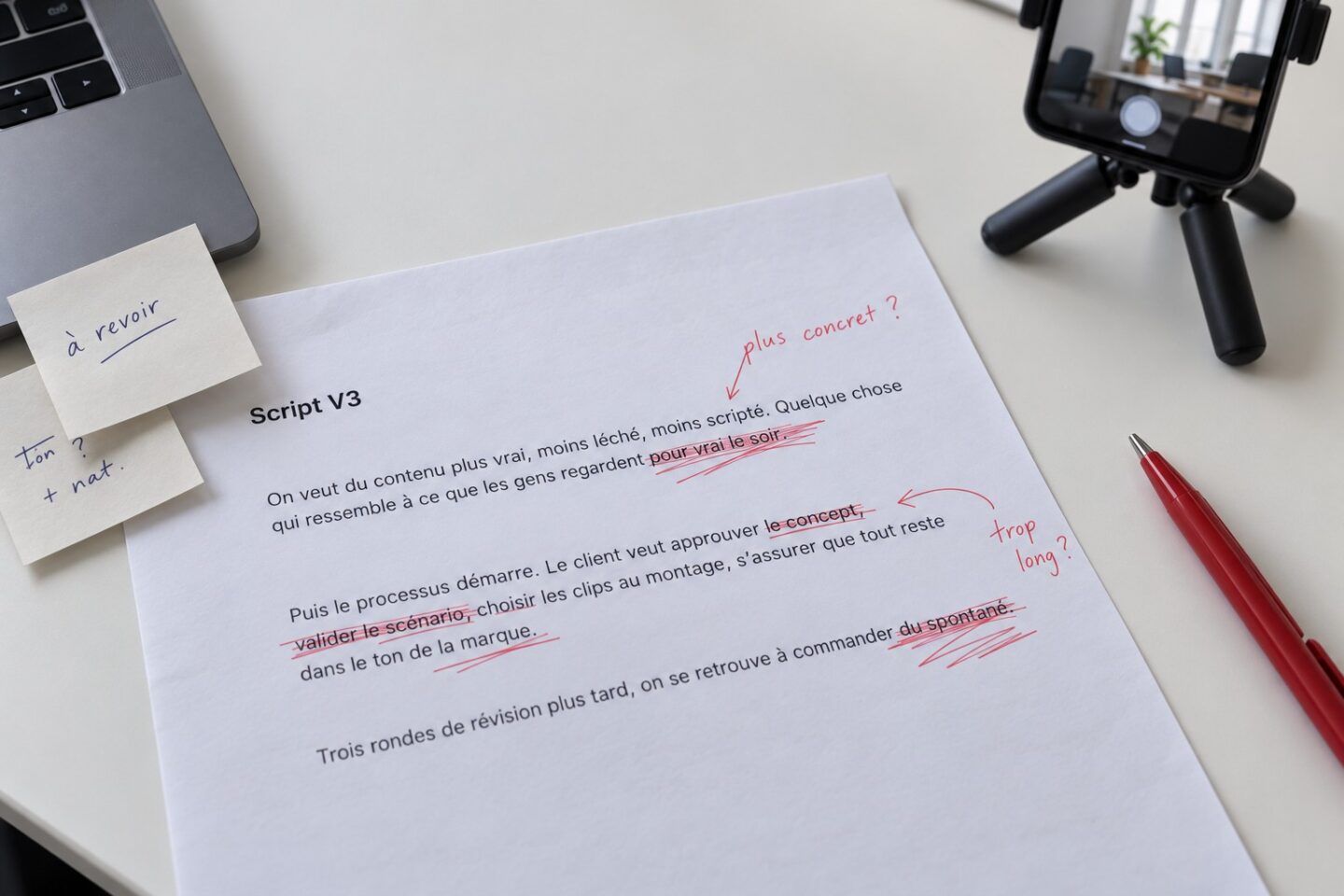
It’s a request that comes up with almost every new engagement. The client wants content that feels more real, less polished, less scripted. Something that looks like what people actually watch at night. Then the process starts. The client wants to approve the concept, sign off on the script, pick the clips in the edit, make sure everything stays on brand. Three rounds of revisions later, we’re ordering spontaneity.
This tension has nothing to do with budget or with the talent of the production team. It comes from a misunderstanding about what you’re buying when you buy authentic content.
I talk about this tension in the video that started this piece: Watch it on TikTok.
What are we really asking for when we ask for “authentic content”?
Most of the time, we’re asking for the look. The vertical format, the handheld camera, the natural light, the conversational tone.
That part can be produced. A good team delivers the aesthetic of real content without any trouble, and the result is often quite good. It performs better than a classic ad because it looks less like one.
But that’s not what made the content people hold up as examples take off. Those pieces worked because someone said something nobody had approved in advance. That’s the part you can’t order, and it’s exactly the part you’re trying to reproduce when you ask for authentic.
Why doesn’t authentic content survive approval rounds?
Because authenticity lives in what wasn’t planned. Every round of revisions removes a piece of the unplanned, and by the end there’s none left.
The mechanism is easy to follow. The first round removes the hesitations, because they feel amateur. The second removes the phrasing that’s too personal, because it isn’t quite in the brand’s tone. The third brings back a key message that wasn’t there at the start, because the content has to serve some purpose. Each of those corrections made sense on its own.
The content that comes out of that process is clean, it’s on brand, and it doesn’t look like anything real anymore. The minute you try to control authenticity, it stops being authentic.
What can you approve in authentic content, and what can’t you?
It gets settled before the shoot, well before the edit. Here’s how we separate the two with our clients.
1. You can approve the frame; you can’t approve the moment
Who speaks, on what topic, in what setting, for which audience: all of that gets decided and signed off in advance. What comes out of the person’s mouth while they’re filming can’t be. If the script is written line by line, you’re producing an ad with the aesthetic of authentic content. That’s perfectly fine too, as long as you call it what it is.
2. You can approve the limits; you can’t approve the tone
You can agree in advance on what won’t be said: prices, client names, sensitive topics, commitments you can’t keep. Those are clear guardrails, and they cost authenticity nothing. The repetitions, the hesitations, the way the person says things: that’s what makes them credible.
3. You can approve a veto; you can’t approve the polishing
Nobody has to publish something that doesn’t work for them. Turning down a whole video is a healthy decision. Keeping it and reworking it until it’s smooth again is what gets expensive: you pay for authentic content and end up posting an ad.
4. You can approve the choice of person; you can’t approve how they come across
This is the most important decision of the four, and sometimes the least examined. Choosing someone whose way of being fits the brand settles half the worries in advance. Choosing someone you’ll have to correct on every take guarantees a lukewarm result.
When is control the right instinct?
Very often, and there’s nothing to be ashamed of. In a regulated industry, when a claim commits the organization, when customer data is involved, when someone puts themselves at risk by being on camera, tight control is simply the right instinct.
There are also organizations where the decision chain includes too many stakeholders for unapproved content to get through. And that’s normal. What gets expensive is asking for authentic content while knowing you won’t let it through, and leaving the production team to carry the gap between the two.
The question to ask yourself is simple (and I don’t have a ready-made answer for myself either): are we really ready to make authentic content, or do we want the look without taking the risk? Both answers are acceptable.
Key takeaways
Why doesn’t authentic content work when the brand approves everything?
Because authenticity lives in what wasn’t planned. Every round of revisions removes a piece of the unplanned, and by the end there’s none left. The result is clean, on brand, and it doesn’t look like anything real anymore.
What can a brand control in authentic content?
The frame, the limits, the choice of person and the right not to publish. What can’t be controlled is the tone, the delivery and what comes out in the moment of filming.
Is it wrong to want to approve everything?
No. In a regulated industry, or when a claim commits the organization, tight control is the right instinct. The problem only appears when you order authentic content while knowing you won’t let it through.
Articles reliés

AI-generated product photos: when the image makes people doubt the product
One evening this week, I was shopping for clothes online. A brand I didn't know, pieces I liked.…
When social media isn’t working: the excuse behind the real decision
On discovery calls, we hear some version of the same sentence every week: "TikTok doesn't work for us,"…